

OEM/ODM Custom Doors & Windows Exporting: Technical Standards, Supply Chain Integration, and Future Thermal Trends
In the evolving global building ecosystem, specifying fenestration systems for multi-family, mixed-use, and commercial structures requires bridging high-performance material engineering with precision manufacturing. As a leading OEM/ODM custom doors exporter, navigating global market requirements—ranging from North American NFRC ratings and Title 24 energy mandates to European Passive House standardizations—demands end-to-end operational transparency and technical rigor.
1. Strategic Shift in Global Fenestration Procurement: The OEM/ODM Imperative
Modern developers and tier-1 general contractors are moving away from standard off-the-shelf window and door products. The increasing complexity of architectural designs, coupled with strict municipal building codes, has elevated the necessity for project-specific customization. Sourcing directly from an integrated OEM/ODM manufacturing exporter eliminates the historical disconnect between original product design, submittal documentation, site mock-up validation, and actual field installation performance.
Custom door and window export is no longer merely a transaction of physical commodities; it is a coordinated technical service. High-rise podiums, wrap apartments, and luxury single-family developments demand exact thermal breaks, hurricane-impact resistance (such as Miami-Dade compliance), and custom frame profiles. By maintaining control over profile extrusion, glass insulated glass unit (IGU) assembly, and hardware integration, OEM/ODM partners ensure that structural loads and solar heat gain coefficients (SHGC) match precise structural engineering submittals.
Key Technical Takeaway for Project Engineers
Submitting architectural shop drawings directly to an OEM/ODM manufacturing facility guarantees that structural thermal bridging, sill pan flashing geometry, and mullion structural ratings are calculated under unified engineering oversight. This prevents mid-construction retrofits and ensures compliance during third-party jobsite water testing (ASTM E1105 / AAMA 501.2).
2. Material Science Evolution: Thermally Broken Aluminum vs. Advanced UPVC
Choosing the correct frame substrate is crucial for balancing architectural aesthetics, structural integrity, and thermal performance across diverse climate zones.
Thermally Broken Structural Aluminum Systems
Structural aluminum remains the premier choice for modern minimalist designs requiring narrow sightlines and maximum glass surface areas. However, raw aluminum exhibits high thermal conductivity. Premium OEM/ODM custom door manufacturers mitigate this by integrating continuous polyamide thermal barrier struts (PA66 GF25 reinforced with 25% glass fiber). This thermal break separates the exterior aluminum extrusion from the interior profile, drastically lowering the overall frame U-factor.
- Structural Strength: Exceptional wind load resistance suitable for high-rise commercial facades and coastal hurricane zones.
- Finishing Options: Architectural anodizing and PVDF fluorocarbon coatings capable of resisting harsh UV exposure and salt-spray corrosion.
- Acoustic Attenuation: Capable of supporting heavy triple-laminated glass units achieving STC (Sound Transmission Class) ratings above 42 dB.
Multi-Chambered UPVC Vinyl Systems
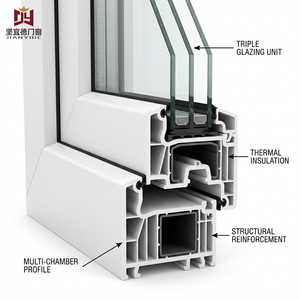
Unplasticized Polyvinyl Chloride (UPVC) offers inherent thermal insulation properties. Modern European-style multi-chambered vinyl profiles feature internal webbed chambers that trap air, acting as natural thermal barriers. When combined with galvanized steel reinforcement cores, high-performance UPVC doors and windows deliver cost-effective compliance for Passive House standards in severe northern climates.
3. Strategic Procurement Trends & Future Outlook (2025–2030)
The global custom door and window export sector is undergoing structural transformations driven by decarbonization policies, smart home integration, and automated manufacturing technology:
1. Low-Carbon EPD Glass & Recycled Alloys
Institutional real estate developers are demanding Environmental Product Declarations (EPDs). Future export contracts prioritize aluminum extrusions produced using renewable hydropower and post-consumer recycled glass IGUs.
2. Vacuum Insulated Glass (VIG) Integration
VIG technology removes the gas space between glass panes, achieving triple-pane thermal performance in double-pane profile thicknesses. OEM/ODM exporters are redesigning sash profiles to accommodate VIG hardware.
3. Automated BIM Level 2/3 Compatibility
Leading exporters provide complete Building Information Modeling (BIM) object libraries, enabling architects to simulate daylighting, solar heat gain, and structural load distributions during pre-construction schematics.
4. The Four-Phase Zero-Defect OEM/ODM Manufacturing & Supply Lifecycle
Drawing from decades of experience partnering with premier developers and trade partners (such as TLS Laboratories, Fortifiber, and major U.S. general contractors), seamless project execution relies on a disciplined four-phase engineering framework:
Phase 1: Pre-Construction & Submittals
Architectural plan review, opening take-offs, custom profile design, engineering calculations, and Title 24/Energy Star energy compliance submittals. Precision procurement timelines are finalized to align with jobsite scheduling.
Phase 2: Jobsite Mock-Up & Water Testing
Full-scale physical mock-up construction. Coordination with window and flashing manufacturers for dynamic water penetration testing (ASTM E331/E1105). Flashing details and weatherization protocols are locked prior to mass production.
Phase 3: Automated Manufacturing & Export Sequencing
Robotic CNC cutting, corner welding, and multi-point hardware assembly under ISO 9001 quality management systems. Crating and container loading are sequenced by building elevation and floor level for streamlined site unloading.
Phase 4: Field Execution & Post-Occupancy Service
On-site or remote field supervision ensuring recessed window sill pan details and WRB (weather-resistive barrier) integration meet design intent. Ongoing warranty service and spare parts support complete the operational loop.
5. Enterprise Advantages: Technical Excellence and Field Reliability
Recessed opening installations represent one of the most demanding waterproofing conditions in commercial building construction. As verified by independent testing facilities (including TLS Laboratories), improper flashing sequence execution at the jambs and sill corners leads to hidden wall assembly failures.
Our OEM/ODM custom export methodology directly addresses this vulnerability. By developing factory-integrated flashing fins, specialized corner seals, and engineered drain channels, we remove guesswork from field crews. This focus on field-proven details is why over 75% of our client portfolio consists of repeat enterprise developers and tier-1 general contractors.