

Featured High-Performance Triple Glazed Window Systems
Explore our engineering-grade triple glazing product portfolio, engineered specifically to satisfy strict Passive House standards, high structural wind loads, and severe thermal insulation criteria across North America and Europe.
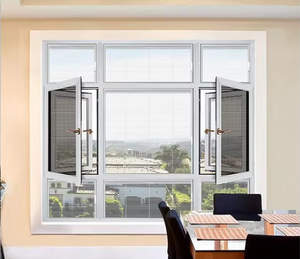
- U-Factor: 0.12 BTU/h·ft²·°F (0.68 W/m²K)
- Impact Rating: ASTM E1886 / E1996 Large Missile
- Frame: Heavy-Duty Thermal Break Aluminum
- Acoustics: Sound Attenuation STC 43 / OITC 36
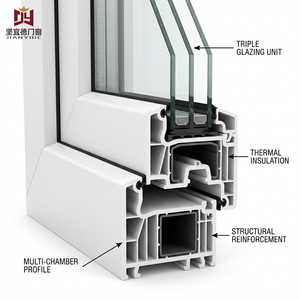
- Profile: 7-Chamber UV-Stabilized Vinyl
- Fill Gas: 98% Argon Cavity Gas Retention
- Glazing: Triple Low-E Glass (Surfaces #2, #4, #6)
- Certification: Energy Star Most Efficient 2026
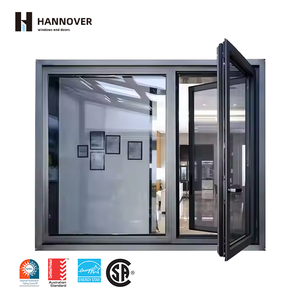
- Hardware: German Siegenia/Roto Multi-Point Lock
- Thermal Break: Polyamide PA66 GF25 Struts
- SHGC Range: 0.18 – 0.35 Customizable
- Testing: NFRC / AAMA 101/I.S.2/A440
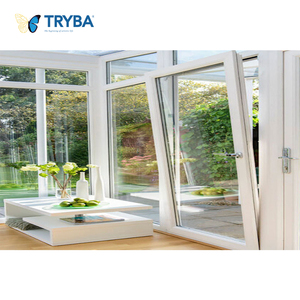
- Glazing Cavity: 48mm Triple Insulated Unit
- Spacer Technology: TPS Warm-Edge Composite
- Air Infiltration: < 0.01 cfm/ft² at 1.57 psf
- Water Resistance: 15 psf (720 Pa) ASTM E331
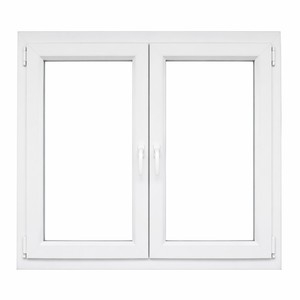
- Application: Podium, Wrap & Multi-Family Housing
- Fire Rating: Class A Interior Flame Spread
- Reinforcements: Galvanized Steel Insert Profiles
- Scalability: High-Volume Automated Production
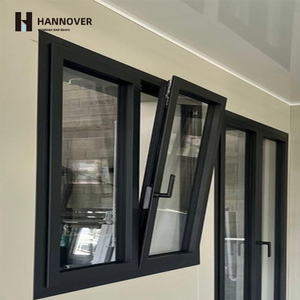
- Alloy Grade: 6063-T6 High-Tensile Aluminum
- Finishes: PVDF Fluorocarbon Coating 20-Yr Warranty
- Gaskets: EPDM Continuous Dual-Durometer Seals
- Configuration: Outswing / Inswing Architectural
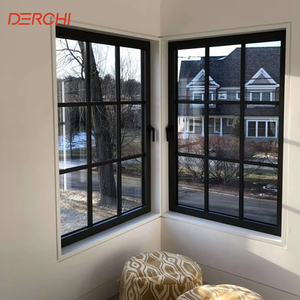
- Visible Sightline: 38mm Ultra-Slim Profile
- Daylight Autonomy: Increased VLT by +14%
- Glazing Matrix: 6mm Low-E + 14Ar + 4mm + 14Ar + 6mm
- Structural Load: Designed for High-Rise Wind Pressure
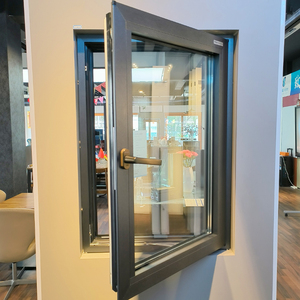
- PHI Standard: Certified Passive House Component
- U-Value (Uw): ≤ 0.75 W/(m²K) [0.13 BTU/h·ft²·°F]
- Core Insulation: Aerogel & Polyurethane Infill
- Acoustic Rating: Noise Reduction up to 46 dB
Executive Overview: Strategic B2B Sourcing for Triple Glazed Systems
In modern high-performance architecture, fenestration selection is no longer a cosmetic choice—it is a critical mechanical calculation. Triple glazing systems have transformed from niche cold-climate solutions into globally demanded components for zero-carbon building enclosures, commercial podium developments, and high-density residential housing projects. As strict energy performance frameworks like California Title 24, ASHRAE 90.1, and the European Union’s Energy Performance of Buildings Directive (EPBD) redefine building envelope standards, procurement officers and structural engineers must source from manufacturers capable of delivering precision thermal breaks, structural integrity, and verified quality control.
Established in 1999, our manufacturing and contracting alliance operates with singular accountability. By bridging the critical gap between OEM manufacturing, custom architectural fabrication, mock-up water testing, field installation supervision, and post-occupancy warranty support, we remove the fragmentation that traditionally risks jobsite delays and waterproofing failures.
Single-Source Liability
Eliminate disputes between window suppliers and installation crews. Our single team manages architectural submittals, factory procurement, jobsite sequencing, water testing, and warranty servicing.
Precision Mock-Up Testing
Before mass factory production, we coordinate jobsite mock-ups with window manufacturers, flashing suppliers, and third-party laboratory engineers to execute water-penetration tests (ASTM E331).
Recessed Water Shielding
Recessed window details represent the construction industry's most challenging leak hazard. We engineer custom sill pans and integrated WRB (Weather-Resistive Barrier) flashing sequences.
The Technical Architecture of High-Performance Triple Glazing
To quantify the information gain of triple insulated glass units (IGUs) over conventional double-pane systems, engineers evaluate the overall thermal transmittance ($U_w$), solar heat gain coefficient ($SHGC$), visible light transmittance ($VLT$), and sound transmission class ($STC$). A standard double-glazed unit with one Low-E coating achieves an average U-factor of 0.28 to 0.32 BTU/h·ft²·°F (1.6–1.8 W/m²K). By contrast, an advanced triple-pane IGU featuring dual soft-coat Low-E layers, warm-edge composite spacers, and 95%+ noble gas infill achieves U-factors as low as 0.11 to 0.14 BTU/h·ft²·°F (0.6–0.8 W/m²K), cutting glass conductive heat losses by over 60%.
| Glazing System Configuration | U-Factor (BTU/h·ft²·°F) | U-Value (W/m²K) | SHGC Range | STC Rating (Acoustics) | Optimal Application Scope |
|---|---|---|---|---|---|
| Standard Double Glazed (Air-Filled) | 0.35 – 0.42 | 2.0 – 2.4 | 0.40 – 0.60 | 28 – 31 dB | Mild climatic zones, budget low-rise |
| High-Perf Double Glazed (Argon + Low-E) | 0.24 – 0.28 | 1.4 – 1.6 | 0.25 – 0.40 | 32 – 35 dB | Standard residential & mid-rise housing |
| Standard Triple Glazed (Dual Low-E + Argon) | 0.13 – 0.16 | 0.7 – 0.9 | 0.20 – 0.35 | 38 – 42 dB | Passive House, cold climates, urban sound control |
| Advanced Triple Glazed (Krypton + Warm Edge) | 0.09 – 0.12 | 0.5 – 0.7 | 0.18 – 0.30 | 42 – 46 dB | Net-Zero High-Rises, extreme environments |
| VIG Hybrid Triple (Vacuum + Triple Cavity) | 0.06 – 0.08 | 0.3 – 0.5 | 0.15 – 0.25 | 45 – 50 dB | Next-Gen architectural iconic skyscrapers |
1. Gas Cavity Optimization & Fluid Dynamics
The width of the gas cavities within a triple glazed assembly determines its convective thermal transfer rate. Research demonstrates that for Argon gas infills, an optimal cavity width of 12mm to 16mm (1/2" to 5/8") creates the maximum insulating barrier. If the gap is narrower than 10mm, conductive heat transfer increases across the gas layer. If the cavity exceeds 18mm, internal convection currents develop within the gas cavity, accelerating thermal loop losses. For projects constrained by overall profile depth, Krypton gas achieves peak thermal performance at a compact 8mm to 10mm gap, though at a higher raw material expenditure.
2. Spectrally Selective Low-Emissivity (Low-E) Coating Placement
In a triple-glazed system, glass surfaces are numbered sequentially from #1 (exterior-facing ambient) to #6 (interior room-facing). Placing soft-coat magnetron sputtered Low-E coatings on Surface #2 and Surface #5 yields optimal thermal reflection for heating-dominated or balanced mixed climates. Surface #2 reflects long-wave solar radiation during summer cooling months, while Surface #5 reflects radiant interior heat back into the living space during winter heating periods.
Future Procurement & Manufacturing Trends in Triple Glazing
As global supply chains adapt to strict ESG (Environmental, Social, and Governance) mandates and embodied carbon evaluations, fenestration sourcing requires long-term strategic forecasting. OEM factories are implementing several transformative innovations:
TPS & Flexible Warm-Edge Spacers
Traditional aluminum box spacers act as thermal bridges along the edge-of-glass perimeter, triggering internal condensation and seal failures. Next-generation factories utilize Thermo Plastic Spacers (TPS) or silicone-foam warm-edge technology directly robotized onto the glass matrix. This reduces perimeter heat loss by up to 15% and guarantees a 30-year gas retention lifespan.
Vacuum Insulating Glass (VIG) Hybridization
To reduce the structural deadweight and sash thickness associated with heavy triple glazing, progressive factories are integrating VIG units as the central or interior pane. A 0.2mm vacuum gap provides insulation equivalent to a 12mm Argon space, allowing manufacturers to engineer ultra-thin triple glazing suitable for historic retrofits and slimline curtain walls.
Embodied Carbon & EPD Traceability
Leading European and North American developers now require Type III Environmental Product Declarations (EPD) for fenestration procurement. Manufacturers are adopting recycled aluminum billets (made with hydro-powered smelting) and decarbonized float glass, reducing the embodied carbon footprint of the window frame and glass matrix by over 35%.
B2B Sourcing Protocol: How to Audit a Triple Glazing Factory
Purchasing agents and facade consultants evaluating overseas or domestic window factories must conduct rigorous quality control audits. To ensure structural compliance and long-term durability, verify that the manufacturer maintains the following quality assurance infrastructure:
A. Automated Secondary Sealant Application: Structural silicone secondary seals (such as Dow Corning 983 or IGK 130) must be applied using automated dual-pump robotic lines. Manual application risks air bubbles and inconsistent seal depth, leading to premature gas leakage.
B. On-Line Argon Concentration Gas Analysis: High-volume factories must employ non-invasive spark emission spectroscopy or optical laser sensors to measure Argon gas fill ratios in real time. Every batch should be logged with a minimum 95% gas concentration seal guarantee.
C. Mock-Up Structural & Water Testing Chambers: Verify that the factory houses in-house AAMA / EN certified test chambers capable of applying cyclic dynamic pressure loads (ASTM E330) and continuous water spray racks (ASTM E331) to simulate hurricane-force rainstorms.
Frequently Asked Questions for Commercial Procurement
Triple glazed IGUs increase glass deadweight by approximately 33% to 50% depending on pane thicknesses (e.g., three 4mm panes weigh ~30 kg/m² vs 20 kg/m² for double glazing). This requires reinforced corner joints, high-load stainless steel friction hinges, heavy-duty roller assemblies on sliding systems, and structural framing engineered to prevent sash sag over time.
While triple glazing was historically engineered for sub-zero climates, modern spectrally selective Low-E coatings make it highly effective in hot climates. By tuning the exterior pane for a low Solar Heat Gain Coefficient (SHGC < 0.20) and utilizing the middle glass pane as an additional radiant barrier, triple glazing dramatically reduces HVAC cooling loads in desert or tropical urban environments.
Standard triple glazing with identical glass thicknesses (e.g., 4mm + 4mm + 4mm) can suffer from acoustic resonance loops, offering only marginal STC gains over double glazing. However, when engineered with asymmetrical glass thicknesses (e.g., 6mm exterior + 4mm center + 8mm laminated interior pane), triple glazing disrupts sound wave frequencies, raising acoustic ratings from STC 32 up to STC 45+.
Buyers should require NFRC (National Fenestration Rating Council) certificates for thermal performance (U-factor, SHGC, VT), AAMA/WDMA/CSA 101/I.S.2/A440 structural performance certification, IGCC/IGMA certification for IGU seal durability, and Passive House Institute (PHI) component seals for net-zero construction projects.
The central glass pane in a triple IGU experiences higher thermal absorption because heat is trapped between two insulating air cavities. To eliminate thermal stress fractures caused by partial shading or high solar absorption, manufacturers must heat-strengthen or fully temper the middle pane.
With modern automated manufacturing narrowing the cost premium of triple glazing to just 10%–15% over high-end double glazing, energy modeling shows a full payback period within 3 to 7 years in Climate Zones 4–8 through reduced HVAC equipment sizing, reduced operational utility costs, and enhanced tenant retention rates.
Request Architectural Submittals & Factory Price Engineering
Consult with our fenestration engineering specialists for custom shop drawings, NFRC thermal calculations, jobsite mock-up planning, and direct factory pricing for your project specifications.
Contact Us