

Featured Commercial Thermal Break Systems
Engineered for High-Rise Residential, Multi-Family Podium Builds, and Extreme Climate Structural Efficiency
The Single Accountability Advantage in Fenestration Procurement
In the commercial multi-family and large-scale residential construction sectors, over 80% of window performance failures—including water infiltration, air leakage, and thermal bridging—occur in the operational gap between the profile manufacturer and the jobsite installation contractor. Our enterprise model bridges this fragmented supply chain. By maintaining end-to-end oversight from architectural submittals and extrusions to mock-up water testing and field installation, we eliminate contractor finger-pointing and ensure strict compliance with strict energy building codes.
Pre-Construction & Engineering
Complete plan review, opening take-offs, custom shop drawings, and Title 24 / NFRC thermal compliance calculations performed directly against architectural specifications before extrusions begin.
Mock-Up & Water Testing
Assembly of full-scale jobsite mock-ups paired with ASTM E1105 field water pressure testing and AAMA 501.2 hose diagnostics alongside third-party waterproofing consultants.
Recessed Opening Mastery
Specialized flashing sequence development for recessed window installations—widely acknowledged as construction's most complex weatherproofing condition—guaranteeing multi-layer drainage continuity.
Industry Insight: According to building envelope field diagnostics, over 65% of air and water leakage in aluminum multi-family installations occurs at the flashing-to-WRB (Weather-Resistive Barrier) interface rather than the window frame core. Unified single-source contracting guarantees integrated weatherization protocols across every unit.
Engineering Trends: Thermal Break Technology Evolution
Thermal breaking in aluminum fenestration represents a critical material science advancement, transforming highly conductive aluminum profiles into hyper-insulated structural building envelopes. Aluminum possesses an inherently high thermal conductivity ($\lambda \approx 160\text{ to }200\text{ W/m}\cdot\text{K}$). Without an engineered thermal break, glass structures suffer massive conductive heat loss, internal condensation, and elevated HVAC energy loads.
Polyamide (PA66-GF25) Structural Barrier Engineering
Modern export-grade thermal break systems have transitioned from older pour-and-debridge polyurethane methods to crimped Polyamide 66 reinforced with 25% glass fiber (PA66-GF25). This composite material closely matches the thermal expansion coefficient of structural aluminum ($\alpha \approx 2.3 \times 10^{-5}/\text{K}$), preventing structural shear failure under extreme ambient temperature fluctuations.
| Thermal Barrier Type | Thermal Conductivity ($\text{W/m}\cdot\text{K}$) | Tensile Strength (MPa) | Max Service Temp (°C) | Primary Commercial Use |
|---|---|---|---|---|
| Standard Aluminum Frame (Unbroken) | 160.0 - 200.0 | 180 - 240 | > 300 | Storefronts & Internal Partitions |
| Pour & Debridge Polyurethane | 0.12 - 0.15 | 40 - 50 | ~80 | Low-Rise Light Commercial |
| PA66-GF25 Polyamide Strip | 0.25 - 0.30 | 80 - 110 | > 200 | High-Rise & Passive House Windows |
| Aerogel-Infused Polyamide Matrix | 0.015 - 0.030 | 70 - 90 | > 220 | Ultra-Low Net-Zero Energy Projects |
Co-Extruded Multi-Chamber UPVC & Hybrid Frame Profiles
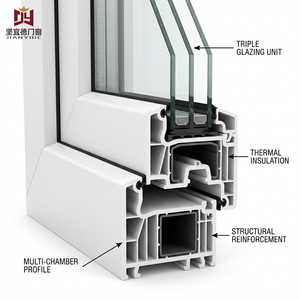
While thermally broken aluminum dominates commercial structural facades, multi-chamber unplasticized Polyvinyl Chloride (UPVC) and aluminum-clad vinyl hybrids have revolutionized cold-climate residential performance. Multi-chamber interior profiles create dead-air insulation pockets that drop system U-factors below 0.18 BTU/h·ft²·°F when paired with triple-pane argon-filled Low-E insulating glass units (IGUs).
Global Sourcing & Procurement Outlook (2025–2030)
Procurement directors, general contractors, and real estate developers face increasingly stringent global carbon compliance targets and supply chain accountability mandates. Navigating thermal break factory procurement requires looking beyond initial FOB unit price to evaluate holistic life-cycle criteria.
1. Decarbonization Mandates & EPD Transparency
Leading international markets now enforce strict embodied carbon thresholds. Top-tier thermal break exporters must provide third-party verified Environmental Product Declarations (EPDs) detailing Cradle-to-Gate carbon footprints. Sourcing low-carbon primary aluminum (smelted using renewable hydroelectric power) combined with recycled content strips reduces structural embodied carbon by up to 60%.
2. Factory Automation & Precision QC Protocols
High-end structural thermal break factories utilize automated knurling, strip insertion, and three-stage rolling crimping lines equipped with real-time shear-strength sensors. Dimensional tolerance checks under ISO 9001 ensure frame corner joints maintain air tightness under high wind-load deflections (ASTM E330).
3. Surface Treatment Durability in Marine Environments
For coastal and high-humidity developments, profile longevity relies on superior surface pretreatment. Leading factories employ AAMA 2605 fluorocarbon (PVDF) 3-coat/3-bake liquid coatings or Class I Anodizing ($>18 \mu\text{m}$ thickness), delivering over 3,000 hours of continuous salt spray corrosion resistance (ASTM B117).
Frequently Asked Sourcing & Technical Questions (FAQ)
Key technical insights to guide general contractors, architects, and purchasing agents through thermal break profile selection and manufacturer validation.
Partner with Proven Thermal Break Engineering Experts
Sourcing complete fenestration packages for multi-family, mixed-use, or high-performance commercial construction? Request technical shop drawings, submittals, or competitive project bids directly from our engineering team.
Inquire Now