

1. Industry Whitepaper: Sliding Door Fenestration Trends in Romania
Romania’s architectural landscape is undergoing a profound structural evolution driven by strict EU Energy Performance of Buildings Directives (EPBD) and mandatory local adoption of Nearly Zero-Energy Buildings (nZEB) standards governed by Order 2641/2017. As real estate development accelerates across tier-one hubs like Bucharest-Ilfov, Cluj-Napoca, Timișoara, Iași, and Constanța, general contractors, architectural firms, and real estate developers face a dual challenge: maximizing natural illumination and continuous aesthetic glass spans while strictly containing building envelope thermal losses.
Traditional sliding door mechanisms are rapidly being phased out in modern Romanian commercial and multi-family residential construction in favor of high-performance Lift-and-Slide (HST) systems and Minimalist Ultra-Slim Aluminum Systems. Standard inline sliding doors frequently fail the stringent air-permeability (EN 12207 Class 4) and watertightness (EN 12208 Class E1050) tests under heavy driving rains common to regional weather patterns. As a direct response, our manufacturing processes integrate continuous multi-point compression seals, multi-chambered polyamide thermal breaks, and specialized EPDM gasket suites designed for thermal expansion stability under temperature swings ranging from sub-zero winters (-20°C) to scorching summer solar loads (+40°C).
2. Technical Specification Matrix: Sliding Door Systems comparison
To assist procurement directors, structural engineers, and facade consultants in matching exact project requirements, the matrix below details the mechanical and thermal performance indicators of our core sliding door configurations exported to the Romanian market:
| System Type | Profile Material & Depth | Thermal Transmittance ($U_w$) | Watertightness (EN 12208) | Acoustic Rating ($R_w$) | Burglar Resistance (EN 1627) |
|---|---|---|---|---|---|
| Lift & Slide (HST 85 Premium) | Thermal Aluminum / 190mm Depth | 0.78 - 0.95 W/m²K | Class E1050 (1050 Pa) | Up to 44 dB | RC2 / RC3 Compliant |
| Minimalist Slim-Frame (Panoramic) | Extruded AlMgSi0.5 / 160mm | 0.82 - 1.05 W/m²K | Class E900 (900 Pa) | Up to 42 dB | RC2 Multi-Lock |
| Heavy-Duty UPVC Sliding (Synego Slider) | 6-Chamber Steel-Reinforced / 80mm | 0.80 - 1.10 W/m²K | Class 9A (600 Pa) | Up to 41 dB | RC2 Standard |
| Parallel Tilt & Slide (PSK 160) | Multi-Chamber Aluminum / 75mm | 0.90 - 1.20 W/m²K | Class E750 (750 Pa) | Up to 45 dB | RC2 Anti-Pry |
| Bi-Fold Accordion Sliding Door | Thermally Broken Al / 77mm | 1.00 - 1.30 W/m²K | Class 9A (600 Pa) | Up to 38 dB | RC2 High-Security |
3. Key Engineering Pillars for the Romanian Climate
Thermal Insulation & Warm-Edge Spacers
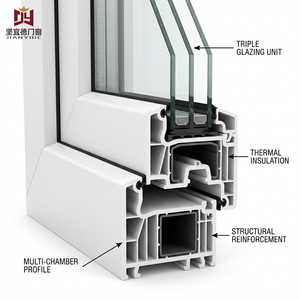
Utilizing multi-chambered structural polyamide thermal break struts (24mm to 39mm width) combined with low-emissivity (Low-E) soft-coat triple glazing filled with 90% Argon gas. Our warm-edge composite spacers eliminate thermal bridging at glass margins, maintaining interior surface temperatures well above dew point during harsh Romanian winters to eliminate condensation.
Acoustic Damping & Urban Isolation
Urban noise pollution along major Romanian arteries (e.g., DN1, Bucharest Ring Road, Cluj Boulevard) demands severe acoustic attenuation. By pairing asymmetrical laminated glass units (e.g., 6mm toughened + 0.76mm acoustic PVB + 4mm + 4mm Low-E), our sliding door systems achieve sound reduction indices up to Rw = 45 dB.
Structural Wind Load Resistance (C5 Class)
Designed to endure severe storm fronts across coastal Constanța and open alpine zones in Brașov and Sibiu. Internal steel profile reinforcements and structural silicone glazing bonding techniques guarantee deflection levels below 1/300 under wind pressure ratings exceeding 2000 Pa (Class C5 under EN 12210).
4. Localized Application Scenarios Across Romania
In urban Bucharest, where land value drives tall residential towers and podium structures, sliding patio doors must combine high-cycle operational durability with sleek aesthetic profiles. Our Lift & Slide Aluminum Door Systems are engineered for sash weights up to 400 kg per panel, enabling floor-to-ceiling glass installations (up to 3.4 meters high) with fingertip glide resistance. Integrated zero-threshold flush track profiles meet universal accessibility norms while preventing water ingress during seasonal urban storm events.
The sub-Carpathian region experiences severe freeze-thaw cycles and heavy snow accumulative loads. Our Passive House Certified UPVC & Aluminum Hybrid Sliding Systems utilize specialized triple EPDM continuous weather stripping and frost-resistant hardware finishes. Frame corners feature internal fusion-welded steel core sleeves or heavy mechanical cleats to preserve structural geometry despite drastic thermal expansion differentials between indoor heating environments and exterior winter cold snap conditions.
Coastal real estate developments require specialized metal treatments to prevent airborne sea-salt oxidation. All aluminum sliding profiles targeted for coastal Romania undergo Seaside-Grade Pre-Anodization and Qualicoat Class 2 Powder Coating (minimum 60-80 microns thickness). Metal hardware components, rollers, and locking gear are upgraded to AISI 316 Stainless Steel, passing 1,000-hour neutral salt spray tests (ISO 9227) without surface pitting or mechanical binding.
5. Enterprise Capabilities & Manufacturing Superiority
With a legacy dating back to 1999, our manufacturing and engineering operations provide direct-to-site supply chain efficiency for general contractors and project developers throughout Romania. As both a system developer and customized manufacturer, we bridge the traditional gap between product design and field execution:
End-to-End Submittal Support
We provide full architectural submittal documentation, customized CAD profiles, BIM (Revit) objects, structural wind load calculation sheets, and Title 24/nZEB thermal compliance certificates tailored for Romanian urban planning submission (Certificat de Urbanism & Autorizație de Construire).
Jobsite Mock-Ups & Water Testing
Before mass production runs, we coordinate structural mock-up assemblies and third-party laboratory air/water pressure testing under EN 1027 standards. Approved jobsite installation sequences guarantee that flashing, sill-pan waterproofing, and WRB integration are standardized across every rough opening.
EU Logistics & Customs Optimization
Operating fully in compliance with EU Construction Products Regulation (CPR 305/2011), all sliding door units carry valid CE markings and Declarations of Performance (DoP). Containerized or flatbed truck transport is floor-sequenced to synchronize with your site crane schedule in Cluj, Bucharest, or Timișoara.
6. Romania Procurement FAQ: Buyer Guidelines
Partner with a Proven Global Sliding Door Manufacturer
Elevate your next commercial or multi-family project in Romania with certified, high-efficiency sliding door systems. Submit your architectural drawings or bill of quantities for rapid engineering review and factory-direct pricing.